

Nissan Oil Change Schedule
If you’re not sure about when to change the oil of your Nissan, you can always look it up online or check the owner’s manual for your model year. Current models have the same two mileage ranges before the vehicle needs an oil change, with one range for conventional oil and the other range for synthetic oil. Clean oil is important to the internal combustion engine’s health, as well as proper driving performance and fuel economy. Here’s everything you need to know about changing the oil in your Nissan to help you set up an oil change schedule.
When Should You Change the Oil in a Nissan?
If you check any standard passenger Nissan vehicle owner’s manual from a recent model year, you’ll see the same statement about oil changes: down to your oil, and the product itself will give a range on how long it lasts. With this in mind, we can look at the typical ranges for engine oil: 3,000-5000 miles for conventional oil and 7,500-10,000 miles for synthetic oil. Nissan also recommends changing the filter along with the oil each time.
It’s a good idea to log the date and odometer each time you change the oil and then count the miles from there. That way, you know when you’re in the window to change it again. For optimal performance, be sure to always fill up with the recommended amount of oil for your engine.
The average miles driven per year in Texas is just over 16,000, so you might drive often enough that you need to change your oil two to three times a year. However, if you don’t drive much, it’s good to still change your oil at least every six months. This is partly because short trips that don’t warm the engine are harder on a vehicle’s system and can cause faster oil degradation.
Conventional Versus Synthetic Oil
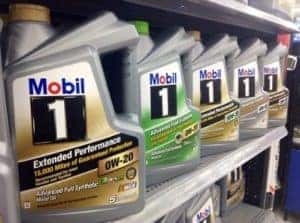
Mobil 1 Synthetic Motor Oil by Mike Mozart is licensed with CC BY 2.0
Conventional oil is an older form of engine lubricant that usually costs less. Synthetic oil generally works better and lasts longer, and some have engine protectants added to them. Most Nissan vehicles today come with synthetic oil recommended, although you could get by with quality conventional oil as well. A person who drives infrequently might be better off with saving money on conventional oil, while drivers who commute or travel daily would benefit from synthetic.
What Factors Make You Need New Oil Sooner?
You might’ve noticed the ranges for Nissan oil changes, such as 7,500-10,000 miles with synthetic oil, are quite large. How you drive and the conditions your car encounters will have a big impact on the lifespan of your oil, so let’s go over the key players:
Time
Driving more miles is the biggest thing that will eat through your oil, but oil will degrade even if you don’t drive for a long time. The longer old oil sits in place, the more easily it can leave deposits that build in the system. From there, you may have to get an oil system cleaning along with your next change.
Model Year
Thanks to continuous improvements in powertrain efficiency, newer cars usually maintain their oil for longer. A Nissan from the past ten years or so is likely to need oil changes later into the expected range so long as you take good care of it and get its other required maintenance tasks done on time.
Conventional Versus Synthetic
Most vehicles by Nissan, like the Altima and Rogue, are filled with synthetic oil when first manufactured. It’s designed to last longer and operate under more extreme temperatures, so you can expect a longer overall number of miles and months before needing to change it. You aren’t forced to use synthetic oil in a modern Nissan, so if you don’t drive very much or very often, you may choose to use conventional oil since it has a shorter window.
Driving Habits
If you tend to go off-roading, the more varied and rugged paths could put further strain on your engine and cooling systems. If you frequently use your Nissan to haul or tow a lot of weight, such as a commercial-use vehicle, you’ll probably need to change your oil more often than average. The same could be true of someone who drives almost entirely on the highway at higher speeds. Frequently driving with a full vehicle or even extra weight in the trunk could also shorten the oil’s lifespan.
Why You Should Change Your Nissan’s Oil
Regardless of mileage, if you see any indications that you should change your Nissan’s oil soon — such as a dashboard warning light, any sort of unusual sounds from your engine, or oil that looks dark or very thick — you should get both it and your filter changed as soon as possible. Driving with dirty, old oil can limit your engine’s ability to disperse heat, making it work harder to maintain a safe temperature. This can have consequences like worsened fuel economy, unusual noises or vibration, and eventually a breakdown.
Our experienced mechanics at South Park Nissan can help look after your Nissan vehicle’s oil changes and other routine maintenance. If you aren’t sure when your last oil change was, feel free to schedule a service checkup to diagnose and solve any pressing concerns.
Why You Should Get Your Oil Changed at a Dealership
Your Nissan should get the chance to serve you at its best. We recommend taking any vehicle to a corresponding dealership centered on that automaker. That way, you’re bound to get faster, more knowledgeable maintenance and repairs. For instance, taking your Nissan to South Park Nissan for oil changes and other auto service means you get the best-priced service and expert advice.
Always remember South Park Nissan when you want an oil change and other routine maintenance for your Nissan done fast and correctly. Our Nissan service department is the best place near San Antonio for things such as Nissan oil and transmission fluid changes, brake replacements, and warranty repair work. We price our services better than generic dealers and will treat you with courtesy and respect. Browse our Nissan service coupons and discount offers to save as much as 20 percent on Nissan oil changes, tire rotation, and more.